
RECOVERY · RESEARCH
BPC-157 and TB-500 in Tissue Recovery Research
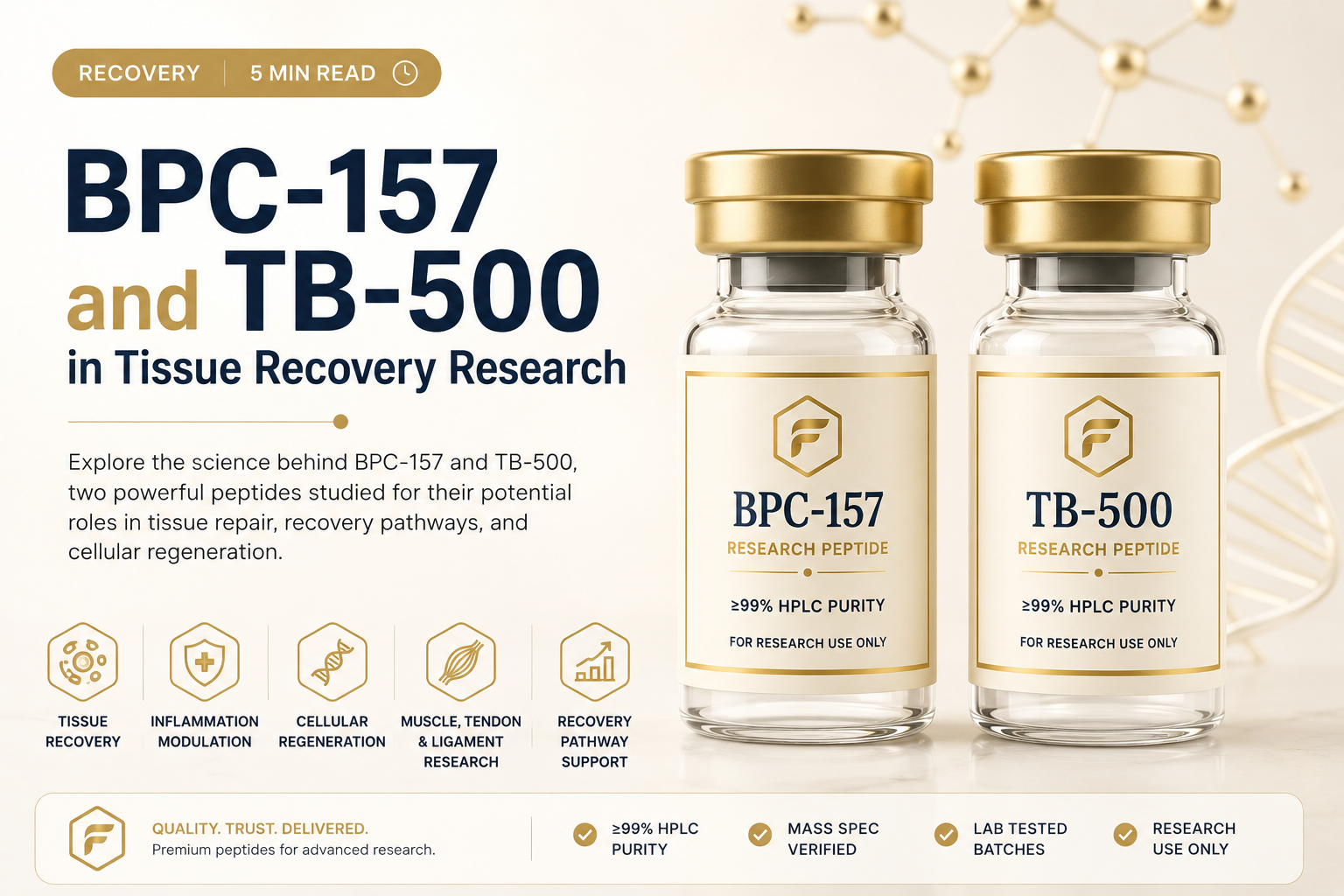
In regenerative peptide research, few compounds are discussed more frequently than BPC-157 and TB-500.
Individually, both peptides have been widely investigated for their potential roles in tissue repair, recovery pathways, inflammation modulation, and cellular regeneration. Together, they are commonly studied as a complementary research combination due to their distinct yet potentially synergistic mechanisms.
As interest in recovery-focused peptide research continues growing, researchers increasingly examine how these compounds may interact within models involving:
- Muscle recovery
- Tendon and ligament research
- Connective tissue studies
- Cellular regeneration pathways
- Inflammatory response modulation
This guide explores the science behind BPC-157 and TB-500, their proposed mechanisms in laboratory research, and why the combination remains one of the most discussed pairings in regenerative peptide studies.
What Is BPC-157?
BPC-157 (Body Protection Compound-157) is a synthetic peptide derived from a naturally occurring gastric protein sequence. In research settings, BPC-157 has been investigated for its potential involvement in:
- Tissue regeneration pathways
- Angiogenesis support
- Tendon and ligament recovery
- Cellular migration
- Gastrointestinal tissue research
- Inflammatory signaling modulation
One of the primary reasons BPC-157 receives attention in regenerative research is its apparent interaction with healing-related pathways connected to nitric oxide signaling, growth factor activity, blood vessel formation, and fibroblast migration. Researchers have explored its potential role in supporting the repair environment surrounding damaged soft tissues.
What Is TB-500?
TB-500 is a synthetic peptide version of a naturally occurring protein fragment known as Thymosin Beta-4. In laboratory studies, TB-500 has been investigated for:
- Cellular migration support
- Tissue remodeling
- Recovery signaling pathways
- Muscle repair research
- Flexibility and mobility studies
- Inflammation-related mechanisms
TB-500 is often studied for its broad systemic activity and its relationship with actin regulation, an important component involved in cellular structure and movement. Its ability to distribute widely throughout tissue systems is one reason it is commonly paired with localized recovery peptides like BPC-157.
Why Researchers Combine BPC-157 and TB-500
Although both peptides are studied independently, many researchers investigate them together because of their potentially complementary properties.
BPC-157 is often associated with localized tissue recovery, tendon and ligament pathways, vascular support mechanisms, and recovery-site targeting.
TB-500 is often associated with systemic recovery signaling, cellular mobility, tissue remodeling, and broad regenerative activity.
Because of these differing characteristics, researchers sometimes study the combination in models designed to evaluate multi-layer tissue recovery, connective tissue adaptation, muscle-to-tendon interaction, and recovery environment optimization.
Tissue Recovery Research Applications
In peptide research literature, BPC-157 and TB-500 are frequently explored in tendon research (stress adaptation, fibroblast activity, collagen organization), ligament research (structural recovery, connective tissue remodeling, blood flow pathways), muscle recovery models (post-strain recovery, repair signaling, inflammation modulation), and joint and connective tissue research (mobility, elasticity, structural integrity).
Potential Mechanisms Being Studied
Researchers continue investigating how these peptides may interact with pathways including:
- Angiogenesis (blood vessel formation)
- Growth factor regulation
- Nitric oxide signaling
- Collagen synthesis pathways
- Cellular migration
- Inflammatory modulation
- Tissue remodeling activity
Why Purity Matters in Recovery Peptide Research
Because regenerative studies often involve sensitive tissue models, compound quality is critical. Low-quality peptide material may contain residual synthesis impurities, oxidized fragments, inconsistent concentrations, or stability-related degradation — variables that compromise experimental reliability and reproducibility.
Researchers therefore prioritize ≥99% HPLC purity, batch-tested compounds, mass spectrometry verification, sterile lyophilization standards, and transparent analytical reporting.
Final Thoughts
BPC-157 and TB-500 remain two of the most recognized peptides in regenerative and tissue-recovery research. Together, they are frequently studied as a complementary combination in models focused on tendon recovery, muscle repair, ligament research, and recovery optimization pathways. As with all research compounds, analytical quality and transparency remain essential — because in regenerative research, consistency is what drives meaningful results.
Disclaimer: Research compounds are intended strictly for in-vitro laboratory and research use only. They are not intended for human consumption, therapeutic use, or diagnostic applications.
RELATED RESEARCH COMPOUNDS
Featured in this article
CONTINUE READING
June 18, 2026
Retatrutide Research Guide: Triple Agonist Compound for RUO Use
A research-use-only technical overview of Retatrutide — naming, identity, the triple agonist mechanism across GLP-1, GIP, and glucagon receptors, and analytical handling notes.
June 14, 2026
Third-Party Testing Explained: Why Janoshik HPLC Certificates Matter
What independent Janoshik HPLC and mass-spec testing actually proves — and how to read a research peptide Certificate of Analysis with confidence.