
REGENERATIVE · PEPTIDES
What Is GHK-Cu?
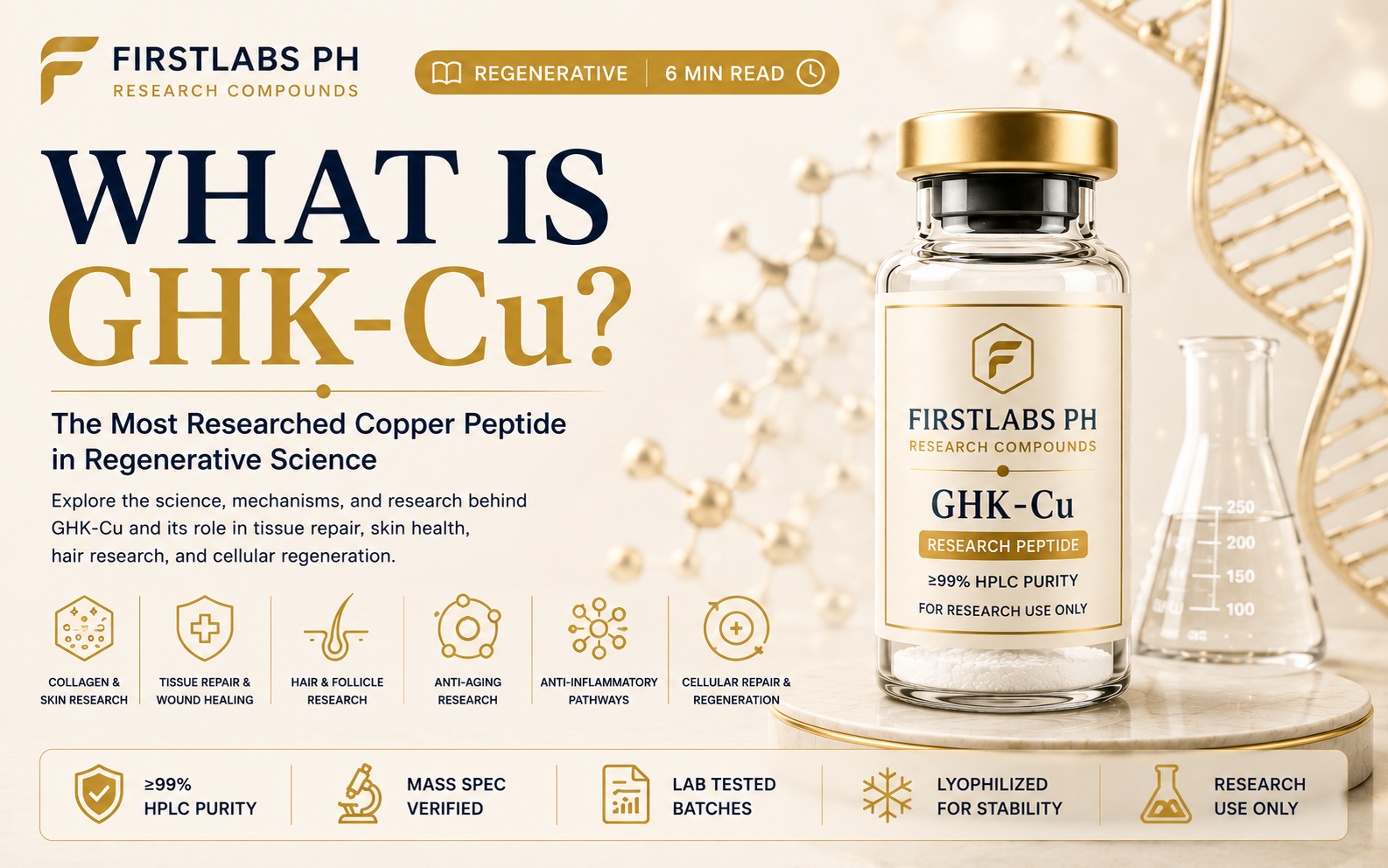
Among the most recognized compounds in regenerative and cosmetic peptide research, GHK-Cu has become one of the most widely studied peptides in investigations involving skin-related pathways, collagen signaling, tissue regeneration, cellular repair mechanisms, and copper peptide research.
Researchers continue exploring GHK-Cu for its potential relationship with skin remodeling, tissue-recovery pathways, hair-related research, longevity-pathway research, and inflammatory signaling modulation. Its broad research profile is one reason GHK-Cu remains highly discussed in both regenerative and aesthetic peptide science.
What Is GHK-Cu?
GHK-Cu is a copper-binding tripeptide made up of glycine, histidine, and lysine combined with copper ions (Cu). This copper-peptide complex is what gives GHK-Cu its distinctive biological research profile.
Researchers investigate GHK-Cu for its potential involvement in tissue remodeling pathways, cellular signaling, collagen-related mechanisms, skin regeneration studies, and recovery-related biological activity.
Why Copper Matters
Copper is an important trace element involved in many biological systems. Researchers study copper-related pathways because they may influence enzymatic activity, tissue remodeling, antioxidant mechanisms, structural protein signaling, and cellular repair processes. When bound to the GHK peptide structure, copper may help support signaling pathways involved in regeneration and repair biology.
Areas of GHK-Cu Research
Skin & Collagen Research
One of the most common areas of investigation involves collagen synthesis pathways, skin elasticity research, dermal remodeling, and structural protein signaling. Researchers continue studying how GHK-Cu may interact with pathways involved in maintaining skin integrity and connective tissue structure.
Wound & Tissue Recovery Research
GHK-Cu is also frequently investigated in studies involving tissue repair pathways, recovery signaling, cellular migration, regenerative mechanisms, and connective tissue adaptation. Its regenerative profile is one reason the peptide is commonly discussed alongside compounds like BPC-157 and TB-500 within broader tissue-recovery research.
Hair & Follicle Research
Researchers also study GHK-Cu in models involving hair follicle signaling, scalp-related pathways, follicular regeneration mechanisms, and growth-related biological activity. This has contributed to growing interest in GHK-Cu within cosmetic and aesthetic peptide research.
Anti-Aging Research
GHK-Cu is frequently explored in studies involving cellular aging pathways, oxidative stress mechanisms, structural tissue integrity, and regenerative signaling. Researchers continue examining whether the peptide may influence biological pathways associated with age-related tissue changes.
Potential Mechanisms Being Investigated
Research involving GHK-Cu commonly focuses on pathways connected to collagen production, elastin signaling, antioxidant mechanisms, inflammatory modulation, cellular communication, tissue remodeling, fibroblast activity, and regenerative signaling. Although research remains ongoing, these mechanisms are central to why GHK-Cu continues receiving attention in regenerative peptide science.
Why GHK-Cu Is Popular in Aesthetic Research
Unlike some peptides studied primarily for metabolic or performance-related pathways, GHK-Cu has become especially popular in skin research, cosmetic peptide science, regenerative aesthetics, and structural tissue studies. Researchers are particularly interested in compounds that may influence skin quality pathways, connective tissue signaling, and regenerative appearance-related mechanisms. This aesthetic-research focus has helped make GHK-Cu one of the most recognizable peptides in cosmetic laboratory studies.
Why Purity Matters in GHK-Cu Research
Regenerative peptide studies require strong analytical consistency. Low-quality compounds may contain residual synthesis impurities, oxidized peptide fragments, copper instability, degraded material, or inconsistent concentrations — variables that may interfere with cellular signaling observations, tissue-response studies, stability analysis, and experimental reproducibility.
Researchers therefore often prioritize ≥99% HPLC purity, mass spectrometry verification, batch-tested compounds, professional lyophilization, and transparent analytical reporting. You can review every batch on our lab reports page.
Why GHK-Cu Is Often Included in Multi-Peptide Blends
GHK-Cu is commonly included in regenerative research blends because of its broad signaling profile. Researchers sometimes combine GHK-Cu with peptides studied for tissue repair pathways, recovery signaling, collagen-related mechanisms, and inflammatory modulation — examples include BPC-157, TB-500, KPV, and LL-37. Our GLOW Blend pairs GHK-Cu with BPC-157 and TB-500 for combined regenerative research applications.
The Future of Regenerative Peptide Research
Modern peptide science is increasingly focused on cellular signaling, regenerative biology, connective tissue research, recovery optimization, and structural tissue integrity. Researchers continue exploring compounds that may influence skin remodeling, tissue regeneration, cellular communication, and recovery-related pathways. GHK-Cu remains one of the most recognized peptides within this evolving field because of its broad regenerative and cosmetic research profile.
Final Thoughts
GHK-Cu remains one of the most discussed peptides in regenerative and aesthetic research. Researchers continue investigating its potential involvement in collagen signaling pathways, tissue remodeling, skin-related mechanisms, hair-related biological activity, and regenerative cellular signaling. Its copper-binding structure and broad research profile are what continue making it one of the most recognized peptides in modern regenerative science.
As with all research compounds, analytical quality matters. Reliable peptide research begins with verified purity, batch consistency, professional testing, and transparent laboratory standards — because in regenerative peptide science, consistency and precision remain essential.
Disclaimer: Research compounds are intended strictly for in-vitro laboratory and research use only. They are not intended for human consumption, therapeutic use, or diagnostic applications.
RELATED RESEARCH COMPOUNDS
Featured in this article
CONTINUE READING
June 18, 2026
Retatrutide Research Guide: Triple Agonist Compound for RUO Use
A research-use-only technical overview of Retatrutide — naming, identity, the triple agonist mechanism across GLP-1, GIP, and glucagon receptors, and analytical handling notes.
June 14, 2026
Third-Party Testing Explained: Why Janoshik HPLC Certificates Matter
What independent Janoshik HPLC and mass-spec testing actually proves — and how to read a research peptide Certificate of Analysis with confidence.