
QUALITY · LAB REPORTS
How to Read a Peptide Lab Report
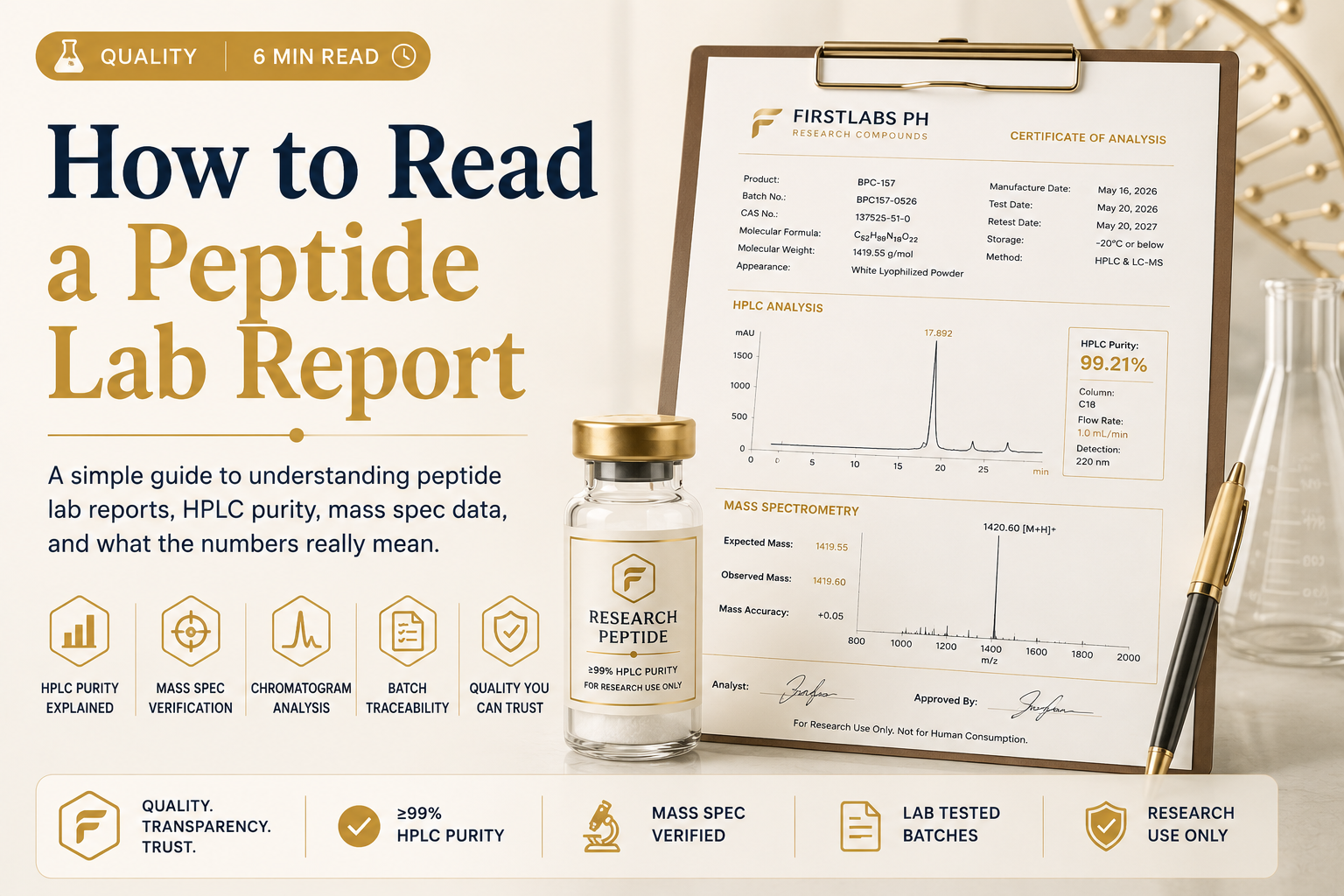
In research peptide sourcing, few things are more important than analytical transparency. A professional peptide supplier should not simply claim "high purity" or "lab tested" — instead, they should provide detailed analytical documentation that allows researchers to evaluate compound quality directly.
This is where peptide lab reports — commonly known as COAs (Certificates of Analysis), HPLC reports, or analytical test reports — become essential. Understanding how to read these reports helps researchers evaluate purity, compound identity, batch consistency, stability indicators, and manufacturing quality.
This guide explains the most important sections of a peptide lab report, what the numbers actually mean, and the key red flags researchers should watch for. You can review every batch report on our lab reports page.
What Is a Peptide Lab Report?
A peptide lab report is an analytical document showing test results for a specific peptide batch. These reports are designed to verify purity percentage, molecular identity, batch information, analytical methods used, and quality-control standards.
Professional reports are typically generated through internal quality-control laboratories, third-party analytical labs, HPLC testing systems, and mass spectrometry verification. A legitimate report should always correspond to a specific batch — not just a generic template.
What Is a COA?
COA stands for Certificate of Analysis. A COA summarizes the analytical data associated with a peptide batch. Most peptide COAs include:
- Product name
- Batch number
- Manufacturing date
- Test methods
- Purity results
- Storage recommendations
- Analyst verification
The COA acts as the peptide's analytical identity record.
The Most Important Parts of a Peptide Lab Report
1. Product Name
The report should clearly identify the compound being tested — for example BPC-157, Tirzepatide, Retatrutide, TB-500, or Semax. This may seem obvious, but vague or incomplete naming can sometimes indicate poor-quality documentation.
2. Batch or Lot Number
Every professionally tested peptide should have a unique batch number or lot identification code. This helps verify batch traceability, manufacturing consistency, and report authenticity. If multiple peptide batches share identical reports, that is often a red flag.
Understanding HPLC Purity
One of the most important sections of any peptide report is HPLC purity. HPLC stands for High-Performance Liquid Chromatography — an analytical method that separates compounds within a sample to determine purity levels.
For example, an HPLC purity of 99.21% means 99.21% of the tested sample corresponds to the target peptide compound. The remaining percentage may consist of synthesis byproducts, truncated peptide fragments, residual solvents, oxidized material, or minor impurities.
Why ≥99% Purity Matters
In peptide research, small impurity differences matter. A compound tested at 95% purity may contain five times more impurities than a 99% sample. Higher purity generally contributes to better consistency, more stable experimental conditions, reduced interference, and improved reproducibility. Researchers often prioritize ≥99% HPLC purity, especially in advanced metabolic and regenerative peptide studies.
How to Read an HPLC Chromatogram
Most peptide reports include a chromatogram — a graph visually representing the compounds detected within the sample.
Main peak. The tallest peak usually represents the target peptide. A clean primary peak generally suggests strong purification, high compound concentration, and lower impurity presence.
Secondary peaks. Smaller peaks may indicate impurities, degradation compounds, synthesis leftovers, or oxidized fragments. Fewer secondary peaks typically indicate cleaner analytical quality.
Retention time. Retention time refers to how long the peptide takes to pass through the chromatography system. Consistent retention timing across batches helps support manufacturing consistency, compound stability, and proper synthesis accuracy.
What Is Mass Spectrometry?
Many professional peptide reports also include Mass Spectrometry (MS). Mass spectrometry confirms molecular weight, structural identity, and correct peptide composition. This is important because HPLC confirms purity, while mass spectrometry confirms identity.
A peptide can appear "pure" but still be the wrong compound if identity is not verified properly. This is why advanced peptide analysis often combines HPLC and MS verification together.
Lyophilization & Appearance Notes
Some reports also include physical appearance, powder consistency, solubility observations, and lyophilization notes. Properly lyophilized peptides often appear as white powder, white cake, or off-white lyophilized material. Inconsistent appearance may sometimes indicate moisture exposure, improper storage, degradation, or manufacturing inconsistencies.
Storage & Stability Information
Professional reports may include storage recommendations such as refrigerated storage, frozen storage, protection from light, and moisture prevention. Peptides are sensitive compounds, and improper storage may affect stability, structural integrity, and research consistency.
Common Red Flags in Peptide Lab Reports
Researchers should be cautious if reports:
- Look blurry or edited
- Lack batch numbers
- Show incomplete chromatograms
- Do not list testing methods
- Use generic templates for every product
- Have inconsistent formatting
- Contain impossible purity values
- Lack third-party verification
Transparency is one of the strongest indicators of professional quality standards.
Why Third-Party Testing Matters
Independent analytical verification adds another layer of confidence. Third-party testing helps confirm report accuracy, purity consistency, batch legitimacy, and reduced manufacturer bias. As peptide research grows, researchers increasingly prioritize suppliers that provide transparent testing, batch-specific reports, and professional analytical documentation.
The Role of Lab Reports in Research Quality
In modern peptide research, lab reports are no longer optional. They help researchers evaluate analytical quality, purity standards, compound legitimacy, manufacturing consistency, and research reliability. The best peptide suppliers understand that transparency builds trust — professional reporting demonstrates a commitment to scientific standards, consistency, quality assurance, and reliable analytical practices.
Final Thoughts
Learning how to read a peptide lab report is essential for evaluating research compound quality. A trustworthy peptide report should clearly provide product identity, batch information, HPLC purity data, chromatogram analysis, mass spectrometry verification, and transparent analytical reporting.
In advanced peptide research, quality is not determined by marketing claims alone — it is determined by measurable analytical standards. Because in serious laboratory research, transparency matters just as much as purity itself.
Disclaimer: Research compounds are intended strictly for in-vitro laboratory and research use only. They are not intended for human consumption, therapeutic use, or diagnostic applications.
RELATED RESEARCH COMPOUNDS
Featured in this article
CONTINUE READING
June 18, 2026
Retatrutide Research Guide: Triple Agonist Compound for RUO Use
A research-use-only technical overview of Retatrutide — naming, identity, the triple agonist mechanism across GLP-1, GIP, and glucagon receptors, and analytical handling notes.
June 14, 2026
Third-Party Testing Explained: Why Janoshik HPLC Certificates Matter
What independent Janoshik HPLC and mass-spec testing actually proves — and how to read a research peptide Certificate of Analysis with confidence.