
QUALITY · LAB REPORTS
Third-Party Testing Explained: Why Janoshik HPLC Certificates Matter
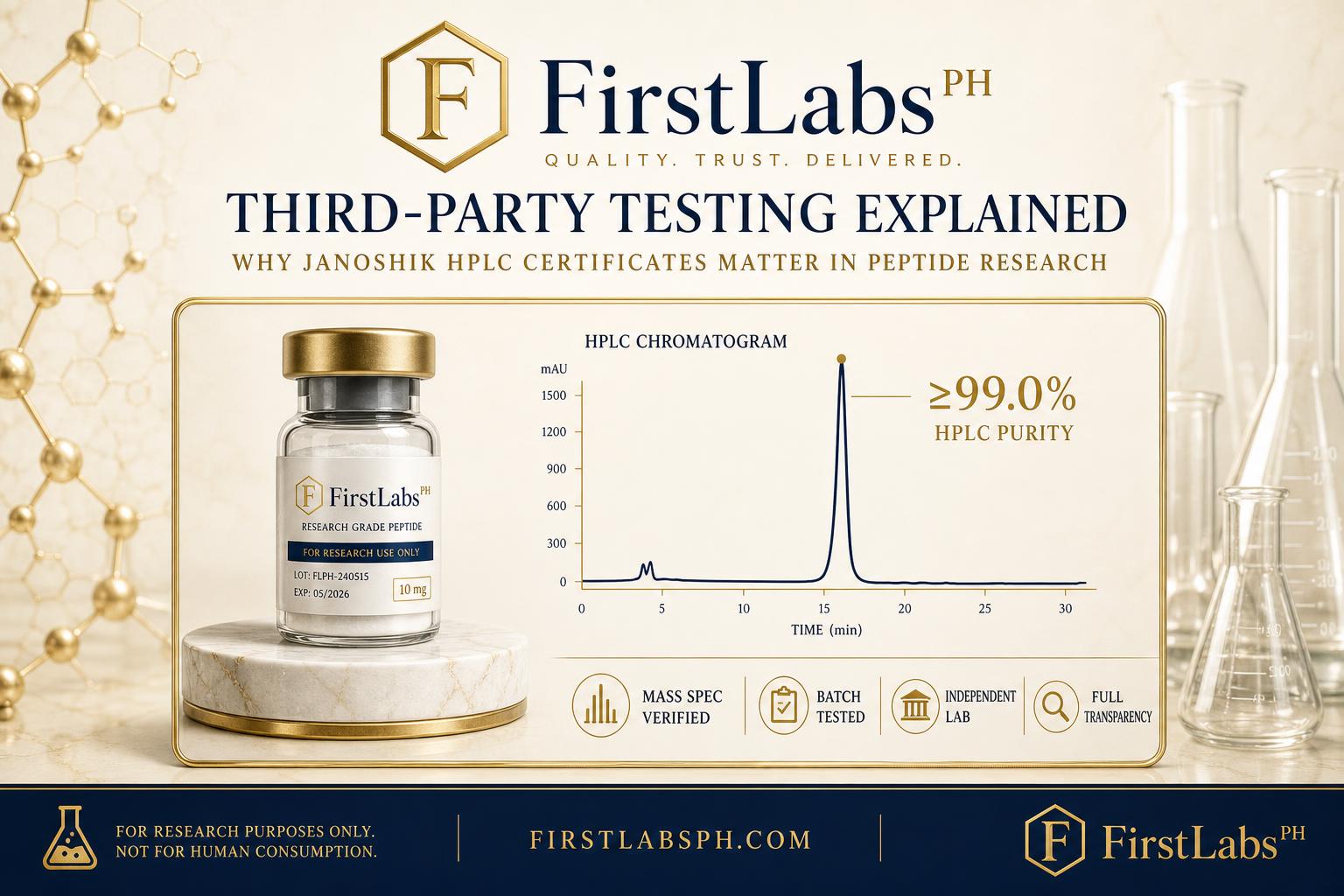
A research peptide's value rises and falls on one number: purity. Third-party testing is how that number is verified by someone other than the manufacturer — and Janoshik Analytical has become one of the most widely referenced independent labs in modern peptide research.
Why Third-Party Testing Exists
In-house testing alone has an obvious conflict of interest: the manufacturer is grading its own work. Independent testing removes that conflict by having an external laboratory analyze a sealed sample and publish the result. Researchers can compare the certificate to the vial in their hand and verify what they're actually working with.
What a Janoshik COA Tells You
- Identity: mass spectrometry confirms the compound matches its expected molecular weight.
- Purity: HPLC quantifies the main peak as a percentage of total area.
- Impurity profile: smaller peaks are documented, not hidden.
- Batch / lot number: ties the certificate to a specific production run.
- Test date: shows when the sample was analyzed.
How to Read an HPLC Chromatogram
An HPLC chromatogram is a graph of detector response vs. time. The compound of interest elutes at a characteristic retention time, producing a tall, narrow peak. Total area under that peak divided by the area of all peaks gives the purity percentage. A clean chromatogram has one dominant peak, a flat baseline, and minimal small impurity peaks before or after the main one.
What ≥99% HPLC Purity Means
A purity of ≥99% means at least 99 of every 100 molecules of measurable material are the target compound. The remaining ≤1% may include synthesis byproducts, related peptide fragments, or trace residuals. For research consistency, lower purity introduces more variables — every additional impurity is another unknown in the system.
Why Mass Spectrometry Matters
HPLC tells you how much of a peak is there. Mass spec tells you what it is. A correctly identified peak with a high purity percentage is the gold standard — purity numbers from an unknown peak prove nothing.
Red Flags on a Certificate of Analysis
- No lab name, signature, or contact information.
- No batch or lot number tying the COA to a specific production run.
- Purity percentage without a chromatogram image to support it.
- Missing mass-spec identity verification.
- An identical COA reused across different batch numbers.
How First Labs PH Handles Verification
Every batch is analyzed by Janoshik Analytical for purity and identity, and every certificate is published openly. You can browse them anytime on our lab reports page.
Important Notice: All products offered by First Labs PH are intended for laboratory and research purposes only. Not for human consumption.
RELATED RESEARCH COMPOUNDS
Featured in this article
CONTINUE READING
June 18, 2026
Retatrutide Research Guide: Triple Agonist Compound for RUO Use
A research-use-only technical overview of Retatrutide — naming, identity, the triple agonist mechanism across GLP-1, GIP, and glucagon receptors, and analytical handling notes.
June 14, 2026
Peptide Half-Life Explained: A Researcher's Guide
Half-life is what determines how often a research peptide is dosed. A plain-English guide to the math, the curves, and what it means at the bench.