
METABOLIC · PEPTIDES · RESEARCH GUIDE
Retatrutide Research Guide: Triple Agonist Compound for RUO Use
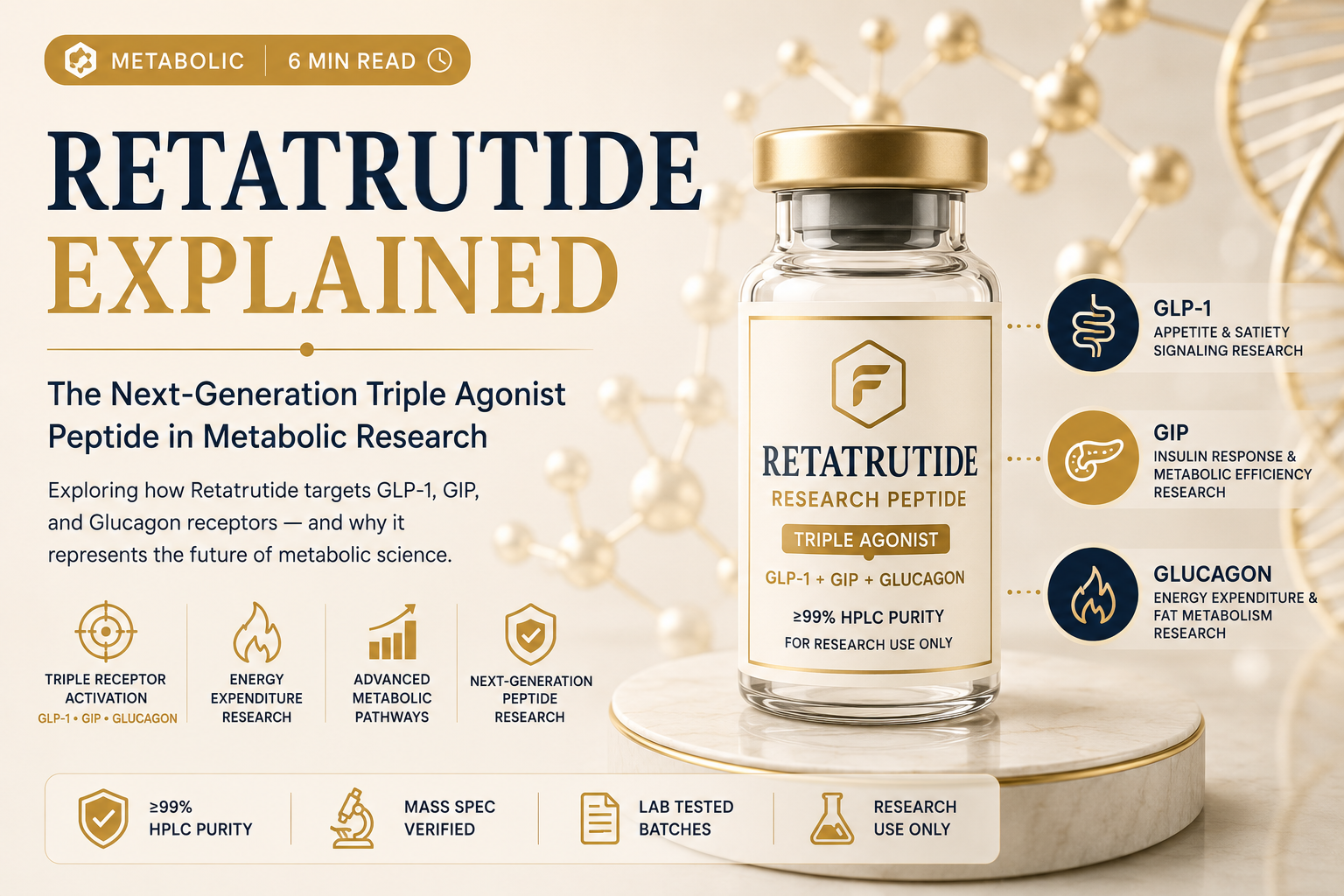
Researchers searching RUO peptide catalogs often look for Retatrutide by several different names. This guide covers the naming, identity, mechanism, and handling considerations researchers most commonly need when evaluating Retatrutide for in-vitro and laboratory use.
Naming and Identity on RUO Research Sites
On research-use-only listings, Retatrutide appears under several interchangeable names:
- Retatrutide — the common research name
- LY3437943 — the developmental code used in early research literature
- CAS 2381089-83-2 — the chemical identifier referenced in COAs
All three identifiers refer to the same triple agonist research peptide. Reputable RUO suppliers publish a Certificate of Analysis tying batch, identity, and HPLC purity to one of these names.
What Retatrutide Is
Retatrutide is a synthetic peptide engineered to interact with three metabolic receptor systems simultaneously — GLP-1, GIP, and glucagon. Earlier-generation incretin research compounds activated one or two of these pathways; Retatrutide is among the first widely studied triple agonists.
The Triple Agonist Mechanism
GLP-1 Receptor
GLP-1 receptor activity is studied for appetite signaling, gastric emptying, and glucose-dependent insulin response.
GIP Receptor
GIP (Glucose-Dependent Insulinotropic Polypeptide) signaling is investigated in the context of insulin response, lipid handling, and nutrient processing pathways.
Glucagon Receptor
Glucagon receptor activity is what separates Retatrutide from dual agonists like Tirzepatide. Researchers study glucagon signaling for its role in energy expenditure, hepatic glucose handling, and fat metabolism pathways.
Why Researchers Choose Retatrutide
The triple agonist profile lets investigators study how simultaneous GLP-1, GIP, and glucagon activation behaves in vitro compared with single- and dual-pathway compounds. This makes Retatrutide a frequent reference compound in next-generation metabolic peptide research.
Analytical and Handling Considerations
- Appearance: lyophilized white powder.
- Purity: reputable RUO batches report ≥99% HPLC purity with mass-spec identity confirmation.
- Storage: store sealed at 2–8°C protected from light; long-term storage at −20°C.
- Reconstitution: typically reconstituted with bacteriostatic water; the exact volume depends on the dosage strength.
- Stability: once reconstituted, store refrigerated and use within the supplier's stated window.
Evaluating an RUO Supplier
When sourcing Retatrutide for research, look for batch-specific Certificates of Analysis from an independent lab such as Janoshik Analytical, identity verification by mass spectrometry, ≥99% HPLC purity, and clearly stated RUO terms. Every First Labs batch is published on our lab reports page.
Comparing Retatrutide With Other Incretin Research Compounds
Compared with single agonists (e.g. semaglutide-class GLP-1 compounds) and dual agonists (Tirzepatide: GLP-1 + GIP), Retatrutide adds the glucagon arm. Researchers comparing mechanisms across compounds often pair Retatrutide studies with Tirzepatide as a reference dual agonist.
Final Notes
Retatrutide — also listed as LY3437943 and CAS 2381089-83-2 — is one of the most studied triple agonist research peptides currently available through RUO channels. Identity, purity, and transparent third-party analytics are the foundation of reliable research, regardless of which incretin compound is being investigated.
Disclaimer: Research-use-only. Retatrutide and all peptides listed on this site are intended strictly for in-vitro laboratory and research use. Not for human consumption, therapeutic use, or diagnostic applications.
RELATED RESEARCH COMPOUNDS
Featured in this article

CONTINUE READING
June 14, 2026
Third-Party Testing Explained: Why Janoshik HPLC Certificates Matter
What independent Janoshik HPLC and mass-spec testing actually proves — and how to read a research peptide Certificate of Analysis with confidence.
June 14, 2026
Peptide Half-Life Explained: A Researcher's Guide
Half-life is what determines how often a research peptide is dosed. A plain-English guide to the math, the curves, and what it means at the bench.