
QUALITY · RESEARCH
Understanding Lyophilized Peptides
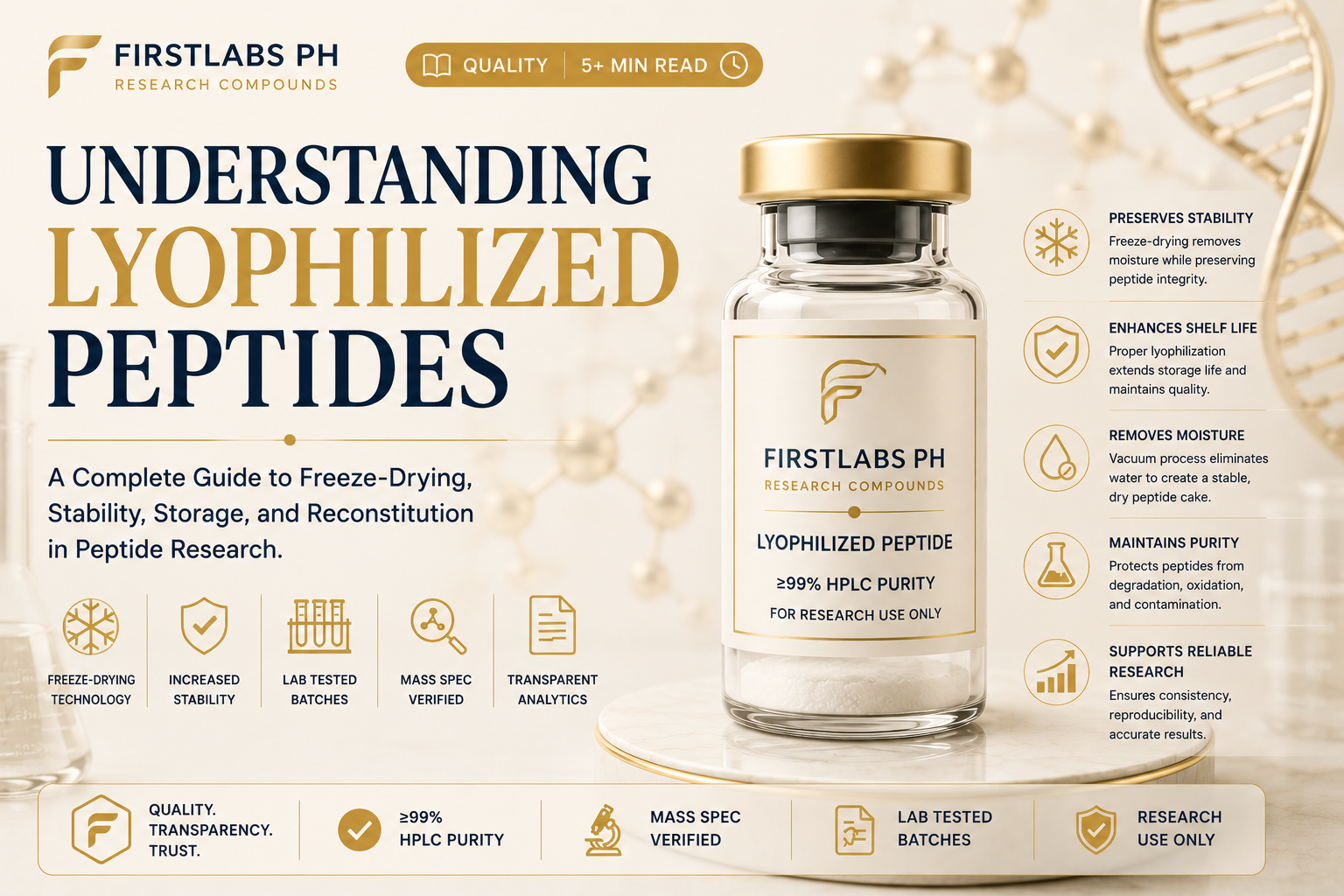
In research peptide science, purity is only part of the equation. Even a highly pure peptide can lose stability, degrade, or become inconsistent if it is not processed and stored properly. This is one reason why most professional research peptides are supplied in lyophilized form.
Lyophilization — commonly known as freeze-drying — plays a major role in peptide stability, storage quality, and long-term preservation. Researchers frequently encounter terms such as lyophilized powder, freeze-dried peptide, lyophilized cake, and reconstitution, but many newer researchers are unfamiliar with what these terms actually mean.
This guide explains what lyophilized peptides are, why freeze-drying matters, how the process works, and why proper handling is critical for maintaining research-grade quality.
What Does "Lyophilized" Mean?
Lyophilization is a scientific freeze-drying process used to stabilize sensitive compounds. In peptide manufacturing, the process removes water from the peptide solution while preserving structural integrity. The final result is typically a dry powder or a solid peptide "cake" inside a sealed vial.
Because peptides are highly sensitive biological molecules, removing moisture helps improve stability, shelf life, transport safety, and storage consistency. This is why most research peptides are distributed in lyophilized form instead of liquid form.
Why Peptides Are Freeze-Dried
Peptides are delicate compounds. Exposure to moisture, heat, oxygen, light, or temperature fluctuations may contribute to structural degradation, oxidation, reduced stability, and reduced analytical consistency.
Lyophilization helps minimize these risks by creating a dry, stabilized form that is less vulnerable to environmental stress. Researchers prioritize freeze-dried peptides because they generally provide better long-term stability, improved storage reliability, and more consistent handling conditions.
How the Lyophilization Process Works
The lyophilization process typically involves three major stages.
1. Freezing Phase. The peptide solution is rapidly frozen at extremely low temperatures. This stabilizes the compound before moisture removal begins. The frozen water forms ice crystals throughout the solution.
2. Primary Drying Phase. Under vacuum pressure, the frozen water undergoes sublimation — meaning ice converts directly into vapor without becoming liquid first. This stage removes most of the moisture from the peptide sample.
3. Secondary Drying Phase. Remaining trace moisture is removed under carefully controlled temperature and vacuum conditions. The final result is a highly dry and stabilized peptide material, which is then sealed inside sterile peptide vials.
What a Properly Lyophilized Peptide Looks Like
High-quality lyophilized peptides commonly appear as:
- White powder
- White "cake"
- Slightly off-white solid material
The texture may vary depending on peptide structure, moisture sensitivity, manufacturing method, and storage conditions. A properly lyophilized peptide often appears dry, uniform, stable, and intact.
Why Appearance Matters
Researchers often inspect peptide appearance because visual inconsistencies may sometimes indicate moisture exposure, improper storage, shipping instability, partial degradation, or poor manufacturing standards.
Potential warning signs may include:
- Excessive clumping
- Wet appearance
- Yellow discoloration
- Collapsed peptide cake
- Residue buildup inside the vial
Although appearance alone does not determine purity, it can provide useful quality indicators.
Why Storage Conditions Matter
Even after lyophilization, peptides remain sensitive compounds. Researchers commonly store peptides refrigerated or frozen depending on the compound and intended research duration. Proper storage helps minimize oxidation, thermal degradation, moisture absorption, and structural instability. Repeated temperature fluctuations may compromise peptide integrity over time.
What Is Reconstitution?
Before laboratory use, lyophilized peptides are typically reconstituted. Reconstitution means adding a liquid solution back into the freeze-dried peptide vial. Researchers use reconstitution to dissolve the peptide, prepare experimental solutions, and create measurable concentrations.
The quality of reconstitution conditions may influence stability, solubility, and handling consistency. This is one reason sterile laboratory handling remains important in peptide research environments.
Why Lyophilization Matters in Research Quality
The freeze-drying process is not just about convenience. It plays a major role in compound preservation, stability consistency, batch reliability, and research reproducibility. Poor lyophilization may contribute to degradation, oxidation, reduced peptide integrity, and experimental inconsistencies.
This is why professional peptide manufacturing prioritizes controlled freeze-drying, moisture management, sterile vial sealing, and cold-chain logistics.
Why Purity Still Matters
Although lyophilization helps preserve peptide quality, it does not replace analytical testing. Researchers still prioritize ≥99% HPLC purity, mass spectrometry verification, batch consistency, and transparent analytical reporting. A properly lyophilized peptide should also demonstrate strong analytical purity, stable structural integrity, and professional manufacturing standards. You can review every certificate of analysis on our lab reports page.
Common Misconceptions About Lyophilized Peptides
"Dry powder means better quality." Not always. A peptide may appear visually acceptable while still containing impurities, oxidized fragments, or poor analytical consistency. Proper testing remains essential.
"All lyophilized peptides look identical." False. Different peptides may vary in texture, density, powder consistency, and cake formation depending on the peptide's chemistry and manufacturing process.
"Freeze-dried peptides last forever." No. Lyophilization improves stability, but peptides still require proper storage, moisture protection, and controlled handling to maintain long-term integrity.
The Future of Peptide Preservation
As peptide science continues evolving, manufacturing standards are becoming increasingly sophisticated. Researchers now expect professional lyophilization, stable cold-chain handling, moisture-controlled storage, analytical transparency, and reliable batch consistency. Preservation quality is becoming just as important as purity itself in advanced peptide research.
Final Thoughts
Lyophilized peptides play a central role in modern research peptide science. Freeze-drying helps improve stability, preservation, storage consistency, and research reliability. However, proper lyophilization is only one part of overall peptide quality.
Reliable research compounds should also demonstrate high analytical purity, professional manufacturing, batch consistency, and transparent testing standards — because in advanced peptide research, preservation and precision go hand in hand.
Disclaimer: Research compounds are intended strictly for in-vitro laboratory and research use only. They are not intended for human consumption, therapeutic use, or diagnostic applications.
RELATED RESEARCH COMPOUNDS
Featured in this article
CONTINUE READING
June 18, 2026
Retatrutide Research Guide: Triple Agonist Compound for RUO Use
A research-use-only technical overview of Retatrutide — naming, identity, the triple agonist mechanism across GLP-1, GIP, and glucagon receptors, and analytical handling notes.
June 14, 2026
Third-Party Testing Explained: Why Janoshik HPLC Certificates Matter
What independent Janoshik HPLC and mass-spec testing actually proves — and how to read a research peptide Certificate of Analysis with confidence.