
EDUCATION · ANALYTICAL SCIENCE
Purity Is Not Quantity: What an HPLC Result Can—and Cannot—Tell You
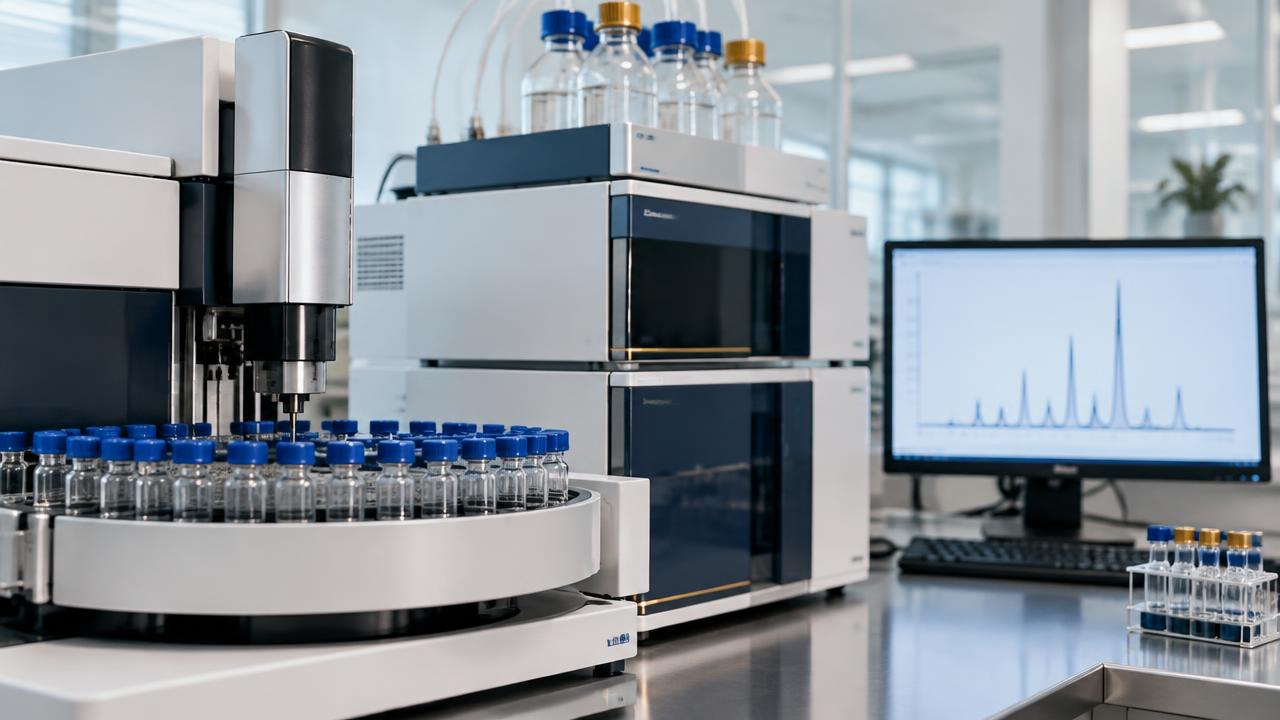
Two reports can answer different questions about the same sample. One may describe the relative size of a chromatographic peak; another may report the measured amount of an analyte. Neither number should be silently substituted for the other.
The useful question is not simply “Is the percentage high?” It is “What exactly did this method measure, and what does the laboratory say the result means?”
Start with the reporting basis
High-performance liquid chromatography, or HPLC, separates components under defined conditions and records detector responses. When a report uses area-normalized purity, the percentage generally compares the assigned peak area with the sum of the included detected peak areas.
Which signals are detected and included depends on the method, detector and processing rules. Different compounds can produce different detector responses. Co-eluting components can also complicate interpretation. For these reasons, area percentage is not automatically a percentage of the sample’s total mass.
Quantity requires its own measurement
A measured amount or concentration requires an appropriate quantitative procedure, including calibration, sample preparation and a stated reporting basis. HPLC can be used for such a procedure; the limitation is not the instrument name but the type of result provided.
For example, a fictional report might list “98% area” and a separate measured quantity in milligrams. The area result describes relative detected signals under that procedure. The milligram result describes an amount under its quantitative procedure. Neither can be calculated from the other without further information.
Do not multiply a labelled powder weight by an area percentage and present the answer as a verified amount. That calculation assumes a relationship the report may not establish.
Identity is another question
A large peak is not, by itself, conclusive identification of the substance. Identity depends on the evidence and selectivity of the identification procedure. Complementary techniques may help resolve uncertainty, but no single technique is universally required for every possible analysis.
ICH Q2(R2) discusses specificity or selectivity, accuracy, precision and reportable range. Its central lesson for readers is that an analytical procedure must be suitable for the question it is intended to answer.
Questions to send to the laboratory
- Is this percentage area-normalized purity, an assay result, or another calculation?
- What method and detector were used, and what components can the method detect?
- Was quantity measured separately, and what unit and basis were reported?
- What supports peak assignment or material identity?
- What limitations or uncertainty should accompany interpretation?
Keep the conclusion narrower than the evidence
Purity, quantity, identity, sterility and stability are separate questions. A report on one does not automatically answer the others. None of these laboratory results alone demonstrates safety for people or clinical effectiveness.
Before comparing results, use the COA verification checklist to confirm the records refer to the same sample or batch.
Source and scope
ICH Q2(R2): Validation of Analytical Procedures, particularly specificity/selectivity and validation for intended purpose. This pharmaceutical analytical guideline is a reference for measurement principles, not a claim of certification for this site. This article offers no dosing or medical-use guidance.
CONTINUE READING
October 23, 2026
Are Peptides Legal in Canada? What Research Use Actually Means
Health Canada regulates injectable peptides as prescription drugs. Here is what that means for research materials, and what a research-use label does not change.
October 23, 2026
Research Peptide Lab Safety: Handling, PPE and Disposal in Canada
Research peptides belong in a laboratory workflow: PPE, ventilation, documented handling and proper disposal. A practical safety overview for Canadian labs.