
COMPARISON · GROWTH HORMONE · TESAMORELIN
Tesamorelin vs Sermorelin, CJC-1295 and Ipamorelin: Research Comparison
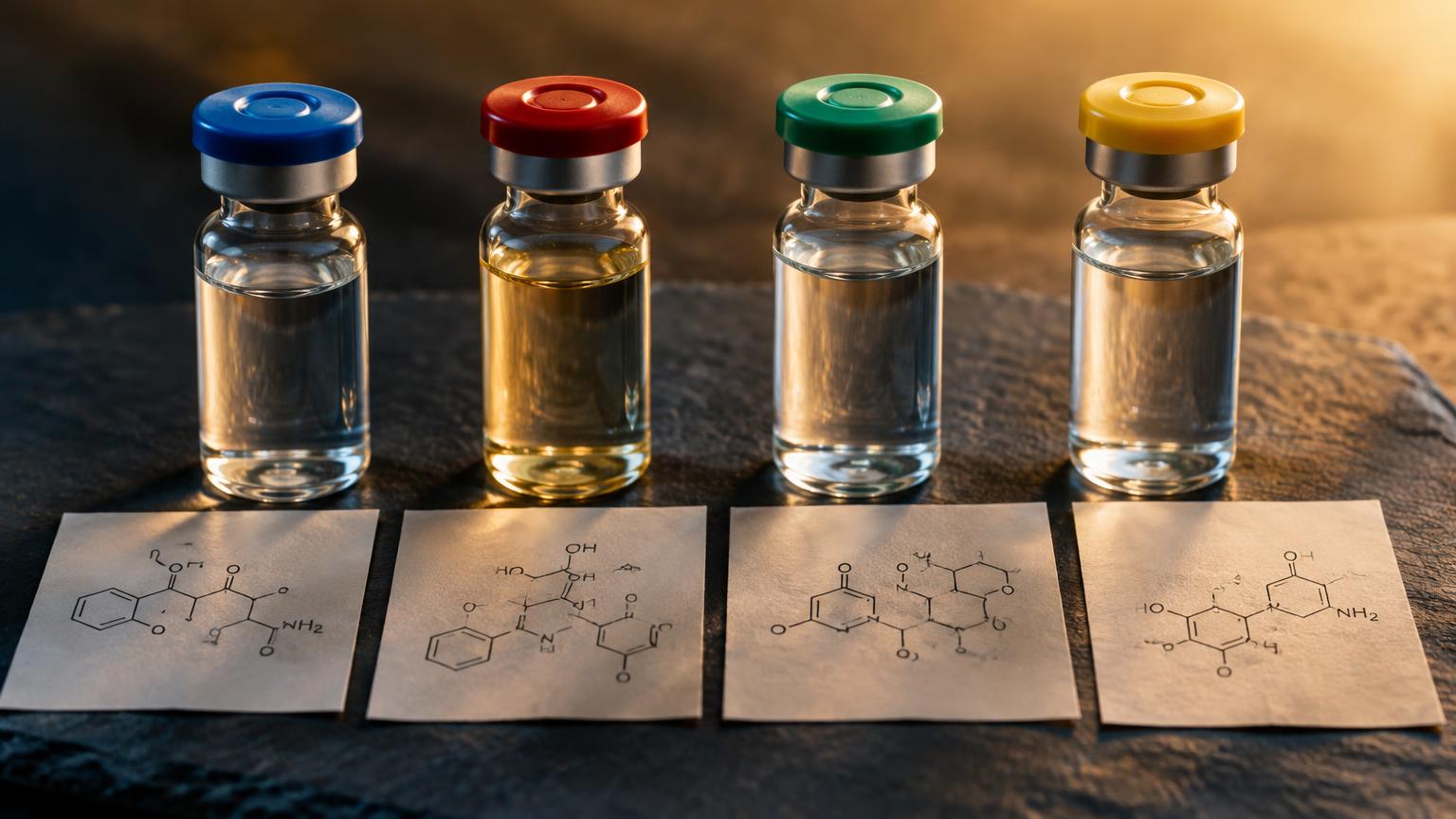
How is tesamorelin different from sermorelin, CJC-1295 and ipamorelin? All four are discussed as growth hormone–related research peptides, but they do not share one mechanism or one evidence base. Tesamorelin and sermorelin are GHRH analogues, CJC-1295 is a long-acting GHRH analogue, and ipamorelin acts at the ghrelin receptor instead.
This original FirstLabs editorial review was updated November 3, 2026. It is educational information, not medical advice, a dosing guide or a recommendation for personal use. FirstLabs catalogue materials are for laboratory research only, not human or veterinary use.
Two receptor pathways
The pituitary releases growth hormone in response to two main signals. GHRH acts at the GHRH receptor. Ghrelin acts at the growth hormone secretagogue receptor (GHS-R1a). Peptides that mimic one pathway are not interchangeable with peptides that mimic the other.
Side-by-side comparison
| Peptide | Pathway | Structure | Key human evidence |
|---|---|---|---|
| Tesamorelin | GHRH receptor | Full 44-amino-acid GHRH sequence with an N-terminal trans-3-hexenoyl modification | Phase 3 visceral-fat trials in adults with HIV; smaller liver-fat and cognition trials |
| Sermorelin | GHRH receptor | First 29 amino acids of GHRH | Older diagnostic and paediatric studies; no current authorization assumed |
| CJC-1295 | GHRH receptor | Modified GHRH analogue designed to bind albumin and last longer | Early pharmacokinetic study in healthy adults (2006) |
| Ipamorelin | Ghrelin receptor | Synthetic pentapeptide | Mostly preclinical and early-phase data |
Evidence volume is a key difference. Tesamorelin is the only compound here with published large phase 3 trials, and those trials apply only to a specific HIV-associated population and endpoint.
CJC-1295: duration is not outcome evidence
Teichman and colleagues reported in 2006 that CJC-1295 produced prolonged increases in growth hormone and IGF-1 in healthy adults. That is pharmacokinetic and hormonal evidence. It does not demonstrate changes in visceral fat, body composition or clinical outcomes comparable to the tesamorelin trials.
Claims to treat with caution
- “Tesamorelin is a stronger CJC-1295”: they share a receptor target but differ in structure, duration and evidence.
- “Stacking a GHRH analogue with ipamorelin is proven”: combination effects are not established by the trials discussed here.
- “Higher growth hormone always means better results”: elevated IGF-1, fluid retention and glucose effects are documented risks of GHRH-pathway compounds.
This page does not recommend combinations, schedules or personal use.
Tesamorelin comparison: frequently asked questions
Is tesamorelin the same as sermorelin?
No. Both act at the GHRH receptor, but sermorelin is a shorter 29-amino-acid fragment and tesamorelin is a modified full-length analogue.
Is ipamorelin a GHRH analogue?
No. Ipamorelin acts at the ghrelin receptor.
Which has the most human trial data?
Tesamorelin, mainly for visceral fat in adults with HIV-associated abdominal fat accumulation.
Laboratory documentation is a separate question
Evidence about tesamorelin in a clinical study does not establish that a FirstLabs vial is equivalent to the studied formulation. A certificate of analysis describes the submitted sample, not medical suitability or regulatory authorization. HPLC purity does not by itself establish quantity, sterility, endotoxin control or a match to current stock.
For laboratory records, verify exact identity and labelled size, analytical methods, measured quantity, sample identifiers and any available lot-to-stock documentation. A laboratory task ID is not automatically a manufacturing lot. Keep missing reports and adverse results visible rather than borrowing evidence from another size.
Catalogue entries: Tesamorelin 10mg, Ipamorelin and CJC-1295 + Ipamorelin, all for laboratory research only. See also the Ipamorelin guide. The cover shows unlabelled illustrative vials, not FirstLabs products.
Read our COA verification checklist, published laboratory reports and Canadian regulation overview for these distinctions.
Primary sources and editorial scope
- Falutz et al. (2007): Tesamorelin randomized trial in HIV-associated abdominal fat
- Teichman et al. (2006), JCEM: CJC-1295 in healthy adults
- U.S. FDA: Egrifta SV prescribing information (2024)
FirstLabs is a research-material supplier with a commercial interest in the compounds discussed, not a licensed pharmacy or an independent medical authority. Results belong to their original study populations, formulations and endpoints. No personal outcome, treatment protocol or authorization of catalogue products is implied.
RELATED RESEARCH COMPOUNDS
Featured in this article
CONTINUE READING
November 3, 2026
Tesamorelin Research in Canada: Visceral Fat Evidence and Limits
What the 15.2% visceral-fat result measured, why it is not body-weight loss, and how historical prescription authorization differs from research vials.
November 4, 2026
Tesamorelin and Liver Fat: What the HIV NAFLD Trials Found
Two randomized trials in adults with HIV measured liver fat. Here is what changed, what did not, and why it is not a fatty-liver treatment claim.