
LAB TECHNIQUE · GUIDES
How to Reconstitute Research Peptides: A Step-by-Step Lab Guide
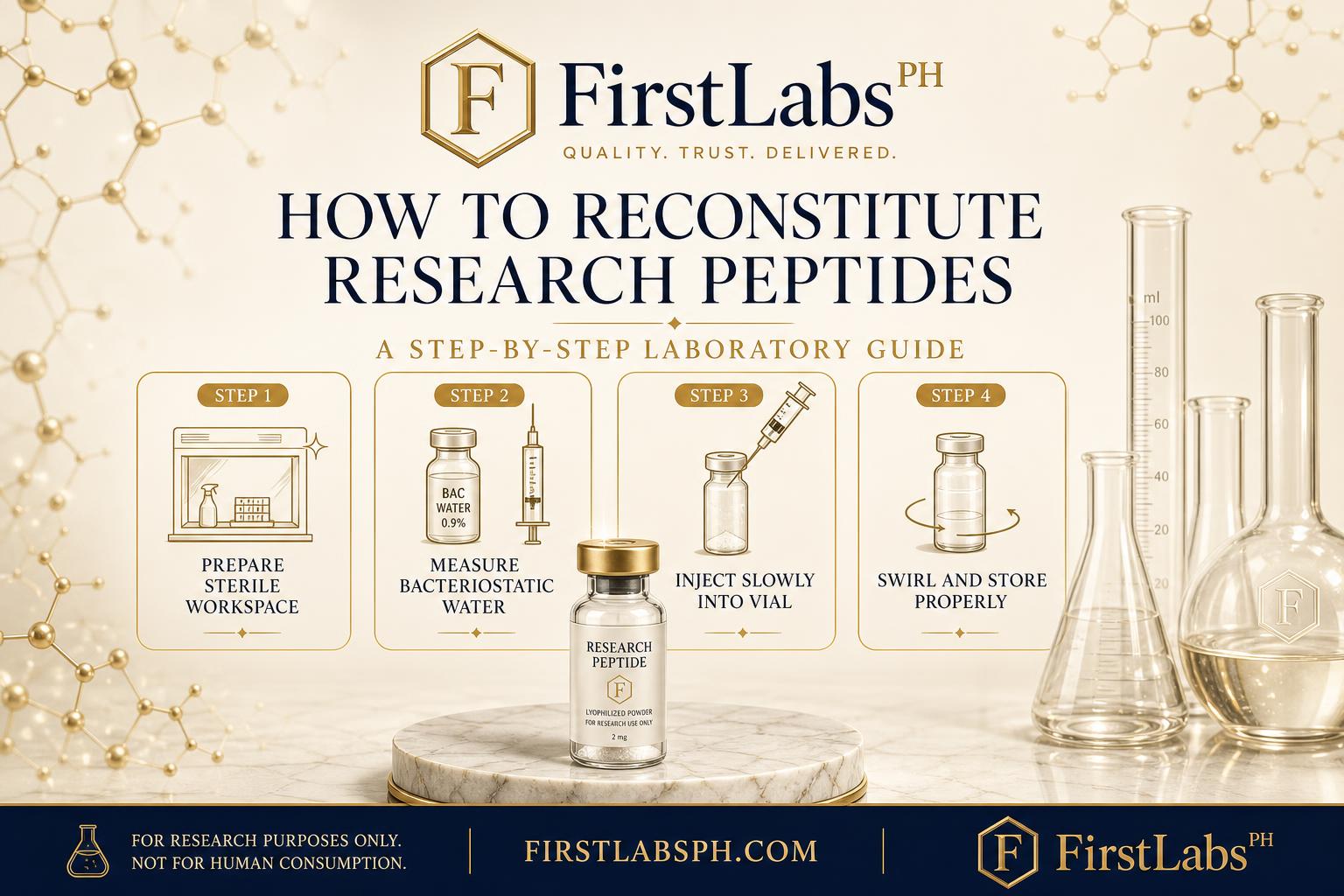
Reconstitution is one of the most common steps in any peptide research workflow — and one of the easiest to get wrong. This guide walks through how researchers prepare lyophilized research peptides using sterile technique and bacteriostatic water.
What Is Peptide Reconstitution?
Lyophilized (freeze-dried) peptides ship as a fine white powder inside a sealed vial. Reconstitution is the process of dissolving that powder in a sterile diluent so the compound can be accurately measured for laboratory research.
The goal is simple: a clear, fully dissolved solution with a known concentration.
Step 1 — Prepare a Sterile Workspace
- Disinfect the bench surface with isopropyl alcohol.
- Wash hands and put on gloves.
- Lay out vial, bacteriostatic water, alcohol swabs, and a new sterile syringe.
- Wipe the rubber stopper of each vial with a fresh alcohol swab.
Step 2 — Choose Your Diluent
Most researchers use bacteriostatic water (sterile water with 0.9% benzyl alcohol) because it inhibits microbial growth and allows reconstituted peptides to be stored for longer in research conditions. Sterile saline or sterile bacteriostatic water is also referenced in protocols depending on the compound.
Step 3 — Inject the Diluent Slowly
- Draw the chosen volume of bacteriostatic water into the syringe.
- Insert the needle into the peptide vial at a slight angle.
- Aim the stream against the inside glass wall — not directly onto the powder.
- Release the plunger slowly to avoid foaming or denaturing the peptide.
Step 4 — Swirl, Don't Shake
Gently swirl the vial in a circular motion until the powder fully dissolves. Never shake aggressively — mechanical stress can damage the peptide structure. If anything remains undissolved after a minute, let it sit at room temperature for a few minutes and swirl again.
Step 5 — Label and Store
- Label the vial with the compound, concentration, and date of reconstitution.
- Store reconstituted peptides at 2–8°C, away from light.
- Use within the timeframe referenced in your protocol.
Simple Concentration Math
Concentration is just mass ÷ volume. A 5 mg vial reconstituted with 2 mL of bacteriostatic water yields 2.5 mg per mL. Drawing 0.1 mL of that solution provides 250 mcg. Always double-check your math before any measurement is taken.
Common Mistakes to Avoid
- Injecting the diluent directly onto the powder pile.
- Shaking the vial vigorously.
- Reusing syringes or needles between vials.
- Forgetting to label the vial after reconstitution.
- Storing reconstituted vials at room temperature long-term.
Why Purity Matters Before You Reconstitute
A clean reconstitution starts with a clean compound. Low-purity peptides can carry residual synthesis byproducts and degradation fragments that complicate research observations. You can review every batch on our lab reports page.
Important Notice: All products offered by First Labs PH are intended for laboratory and research purposes only. Not for human consumption.
RELATED RESEARCH COMPOUNDS
Featured in this article
CONTINUE READING
June 18, 2026
Retatrutide Research Guide: Triple Agonist Compound for RUO Use
A research-use-only technical overview of Retatrutide — naming, identity, the triple agonist mechanism across GLP-1, GIP, and glucagon receptors, and analytical handling notes.
June 14, 2026
Third-Party Testing Explained: Why Janoshik HPLC Certificates Matter
What independent Janoshik HPLC and mass-spec testing actually proves — and how to read a research peptide Certificate of Analysis with confidence.