
LAB TECHNIQUE · STABILITY
Peptide Storage & Stability: Best Practices for Research Labs
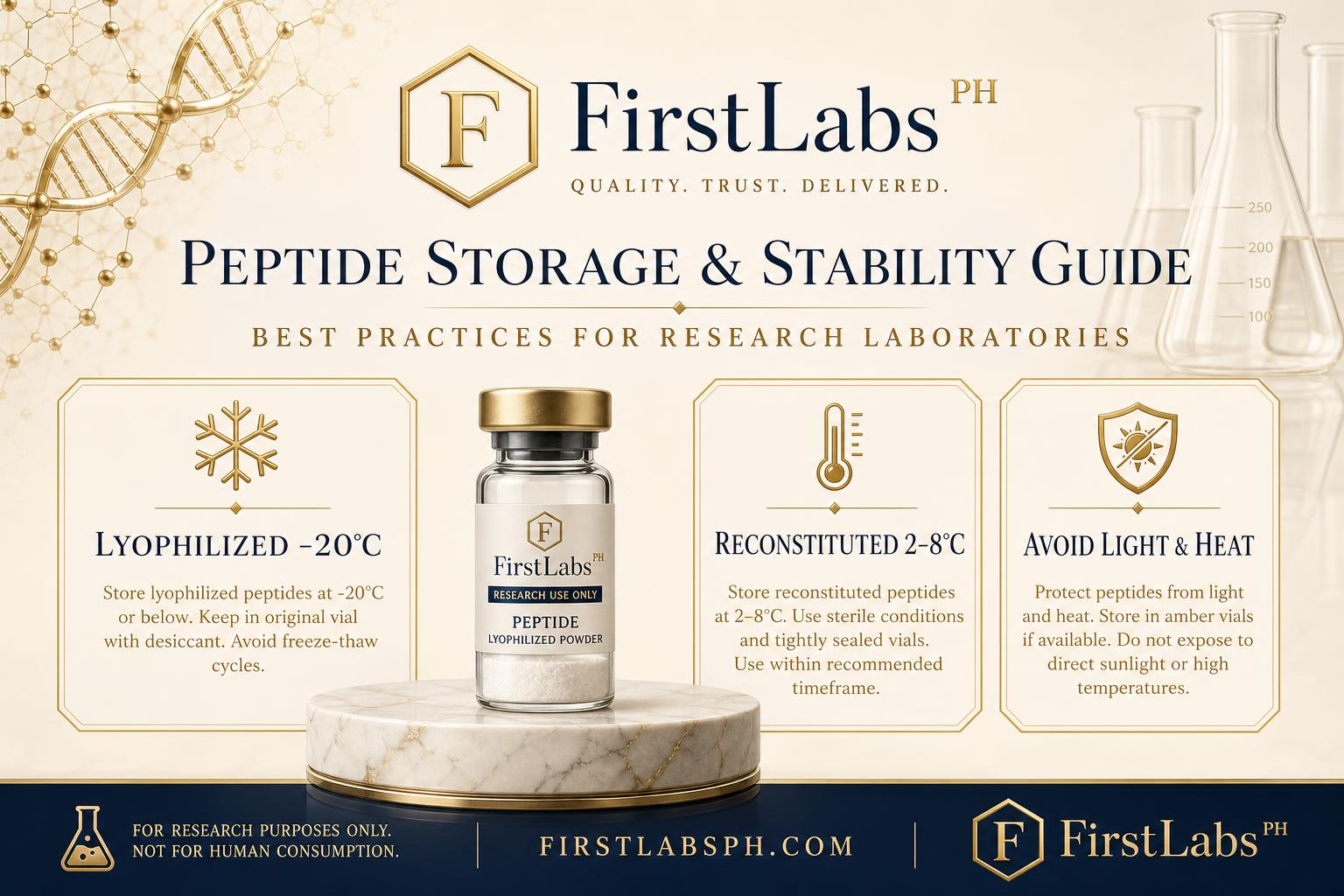
Even the highest-purity research peptide can lose integrity if stored incorrectly. This guide covers the temperature, light, and handling practices researchers use to preserve peptide stability — from arrival to active study.
Why Storage Matters
Peptides are fragile biological molecules. Heat, light, repeated freeze-thaw cycles, and microbial contamination can each contribute to degradation. Proper storage protects the compound's structural integrity and the reproducibility of any research observation.
Storing Lyophilized Peptides
- Temperature: -20°C or below for long-term storage.
- Container: Keep in the original vial with desiccant.
- Light: Store in a dark environment or amber vial.
- Freeze-thaw: Avoid repeated freeze-thaw cycles — aliquot if possible.
Lyophilized peptides are generally stable for 18–24 months when stored frozen and protected from moisture.
Storing Reconstituted Peptides
- Temperature: 2–8°C in a standard laboratory refrigerator.
- Diluent: Bacteriostatic water extends usable life vs. plain sterile water.
- Seal: Ensure the rubber stopper reseals after each draw.
- Light: Keep vials shielded from direct light.
Many reconstituted research peptides remain stable for 2–4 weeks at 2–8°C, though the exact window depends on the compound, diluent, and storage conditions.
Common Stability Threats
- Heat: Accelerates degradation and aggregation.
- Light: Drives oxidation of sensitive residues.
- Repeated freeze-thaw: Mechanical stress can break peptide bonds.
- Contamination: Non-sterile technique introduces microbial growth.
- Vibration / agitation: Shaking can denature the peptide structure.
Best Practice: Aliquoting
For research that spans weeks or months, many laboratories aliquot reconstituted peptide into smaller sterile vials before freezing. Each aliquot is thawed once, used, and discarded — eliminating freeze-thaw degradation in the main stock.
Travel and Shipping Considerations
Lyophilized peptides tolerate short transit times at ambient temperature because they are dry and inherently stable. Once received, they should be moved to long-term cold storage as soon as possible. Reconstituted material should never be transported at room temperature for extended periods.
Verifying Quality Before Storage
Storage best practices only matter if the starting material is verified pure. Every First Labs PH batch ships with a third-party Janoshik HPLC certificate — review them on our lab reports page.
Important Notice: All products offered by First Labs PH are intended for laboratory and research purposes only. Not for human consumption.
RELATED RESEARCH COMPOUNDS
Featured in this article
CONTINUE READING
June 18, 2026
Retatrutide Research Guide: Triple Agonist Compound for RUO Use
A research-use-only technical overview of Retatrutide — naming, identity, the triple agonist mechanism across GLP-1, GIP, and glucagon receptors, and analytical handling notes.
June 14, 2026
Third-Party Testing Explained: Why Janoshik HPLC Certificates Matter
What independent Janoshik HPLC and mass-spec testing actually proves — and how to read a research peptide Certificate of Analysis with confidence.