
BUYING GUIDE · CANADA
Buying Research Peptides in Canada: A Documentation Checklist
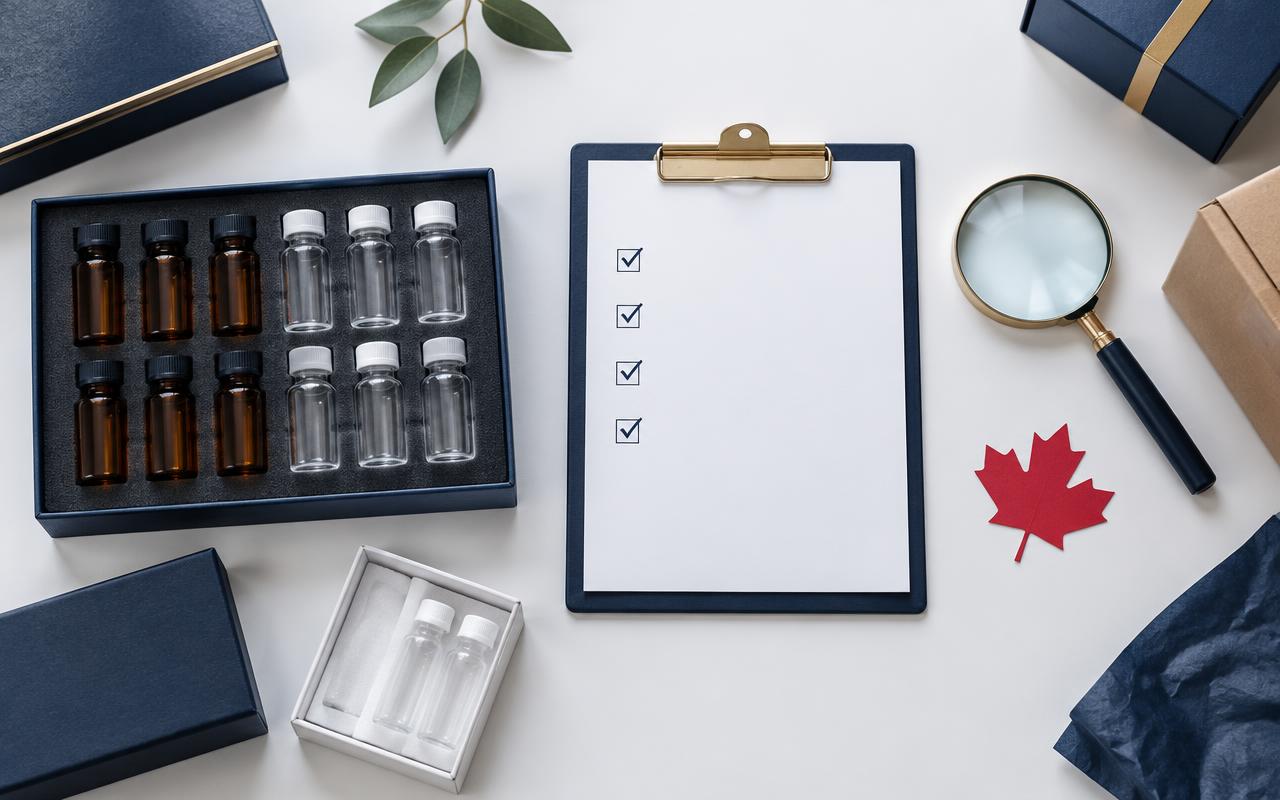
For a Canadian laboratory sourcing research peptides, start with the exact compound, vial size and documentation—not a large purity badge. FirstLabs PH lists prices in Canadian dollars and publishes available reports, but a report for one sample does not establish the quality of every vial or current shipment.
1. Identify the exact product and vial size
Record the compound name, catalogue code and labelled quantity. Sizes are not interchangeable evidence: a BPC-157 10mg certificate does not document a 5mg vial. Some catalogue sizes have no published size-matched certificate; ask for it rather than assuming another report applies.
2. Connect the certificate to the stock you will receive
Check the laboratory, sample description, lot or batch, report identifier and date. A task number identifies the test, not the production batch. If the batch field is blank, request the record connecting the tested sample to the stock offered.
For a concrete example, the published Retatrutide 20mg Freedom Diagnostics certificate lists lot R2055, a reported date of June 9, 2026 and purity of 99.51%. That supports a statement about this tested sample. It does not confirm that today's stock is lot R2055. See our Retatrutide certificate review for exact links and missing identifiers.
3. Read purity, quantity and identity separately
An HPLC purity percentage is not the amount in milligrams, nor a blanket safety assessment. Define the acceptance criteria appropriate to your laboratory's work and compare each reported result against them. A high percentage cannot compensate for missing quantity or traceability evidence.
The rejected Retatrutide 30mg lot RET30-003 illustrates the distinction: its certificate reported 96.97% purity and only 10.82mg measured content against a 30mg label. FirstLabs marks it rejected and not for sale. Read the purity-versus-quantity guide before interpreting a percentage.
4. Compare Canadian prices and ordering terms
Use the catalogue for current CAD prices and available sizes. Quantity deals apply to the same product: 3–4 vials receive 10% off and 5–9 receive 15% off. Eligible products receive wholesale 50% off at 10+ vials; KPV remains on its 15% tier instead. Discount codes may apply to smaller tiers, but not wholesale orders.
Review the shipping policy and the checkout total for delivery charges and timing. Wholesale orders require one week of processing. Do not treat an estimated delivery window as a guarantee.
5. Keep the order and receiving records
Before sending a manual payment, save the order and retain its Order ID. Follow the payment and proof instructions shown at checkout; manual payments remain pending until verified. On receipt, compare the label and supplied documents with the records requested before ordering.
Questions to ask before ordering
- Which report applies to this exact vial size and the stock being shipped?
- Is the identifier a laboratory task number or a production lot?
- Which tests were performed, and which were not reported?
- What are the total CAD cost, shipping terms and processing time?
Compare suppliers without treating a listing as approval
Use our Canadian supplier directory to find official shipping statements and public report pages. The list is unranked and published by FirstLabs, itself a supplier. External testing statements are vendor claims, not independent authentication. A Canadian dispatch address does not establish where a material was manufactured.
A receiving record you can keep
Record the order reference, compound, catalogue ID, labelled vial quantity, received lot label, laboratory task or report number, analysis date and report date separately. Attach the original report and any correspondence connecting the tested sample to the offered stock. Note unresolved discrepancies instead of filling blank fields with assumptions.
If the size, identifiers or units disagree, seek clarification before treating the documents as a matched pair. Review the Canadian research guide library for COA checks, analytical limits and receiving records.
Contact FirstLabs for missing batch documentation, review the published certificates, or compare the research catalogue. For laboratory research only; not for human consumption or treatment.
Sources and scope
FirstLabs published certificates, catalogue and shipping policy, reviewed October 21, 2026. Documentation principles: ICH Q7, sections 11.4 and 17.2. Q7 is cited for documentation education, not as evidence that FirstLabs or these products are certified under it.
RELATED RESEARCH COMPOUNDS
Featured in this article
CONTINUE READING
October 23, 2026
Are Peptides Legal in Canada? What Research Use Actually Means
Health Canada regulates injectable peptides as prescription drugs. Here is what that means for research materials, and what a research-use label does not change.
October 23, 2026
Research Peptide Lab Safety: Handling, PPE and Disposal in Canada
Research peptides belong in a laboratory workflow: PPE, ventilation, documented handling and proper disposal. A practical safety overview for Canadian labs.